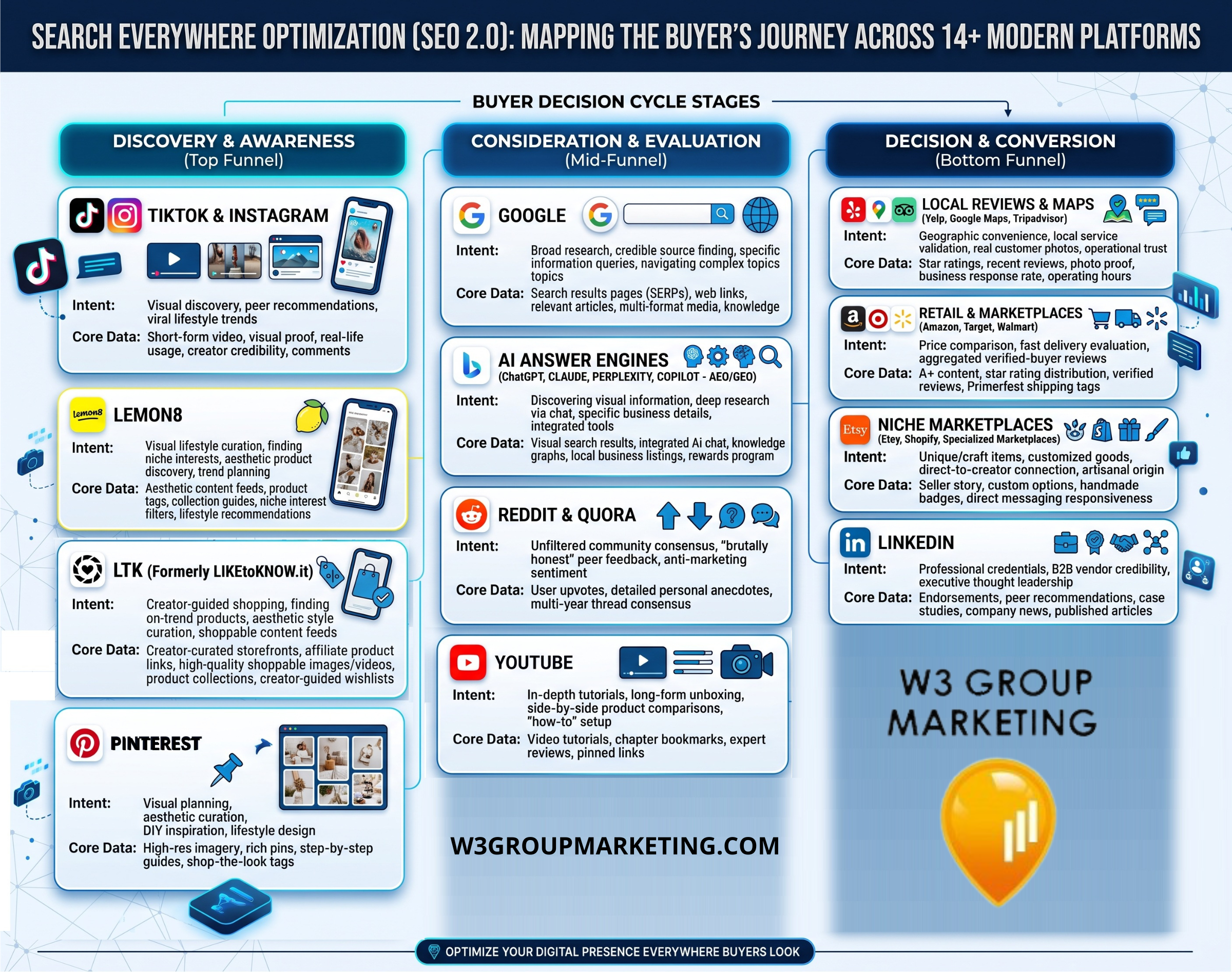

For over two decades, digital marketing relied on a single, fundamental assumption: if you want to be found online, you optimize for Google.
While traditional search engine optimization (SEO) remains a vital pillar of digital marketing, buyer behavior has undergone a massive, permanent shift. Modern consumers no longer rely on a single search bar to make purchasing decisions. They use AI as a search engine or answer engine. They look at socials and review sites, and more. For the how, why, and where you need to show up, read on.
Instead, they consult specialized platforms depending on what they want to accomplish and where they are in their buying journey:
- A consumer looking for home decor inspiration searches Pinterest or Lemon8.
- A shopper seeking genuine product recommendations looks on LTK, TikTok, or Instagram.
- A professional researching software checks LinkedIn or asks ChatGPT.
- A homeowner seeking a reliable local contractor turns to Google Maps, Yelp, or Reddit.
Welcome to the era of Search Everywhere Optimization (SEO 2.0); the practice of building authority, trust, and visibility across every digital touchpoint where modern buyers search, compare, and convert.
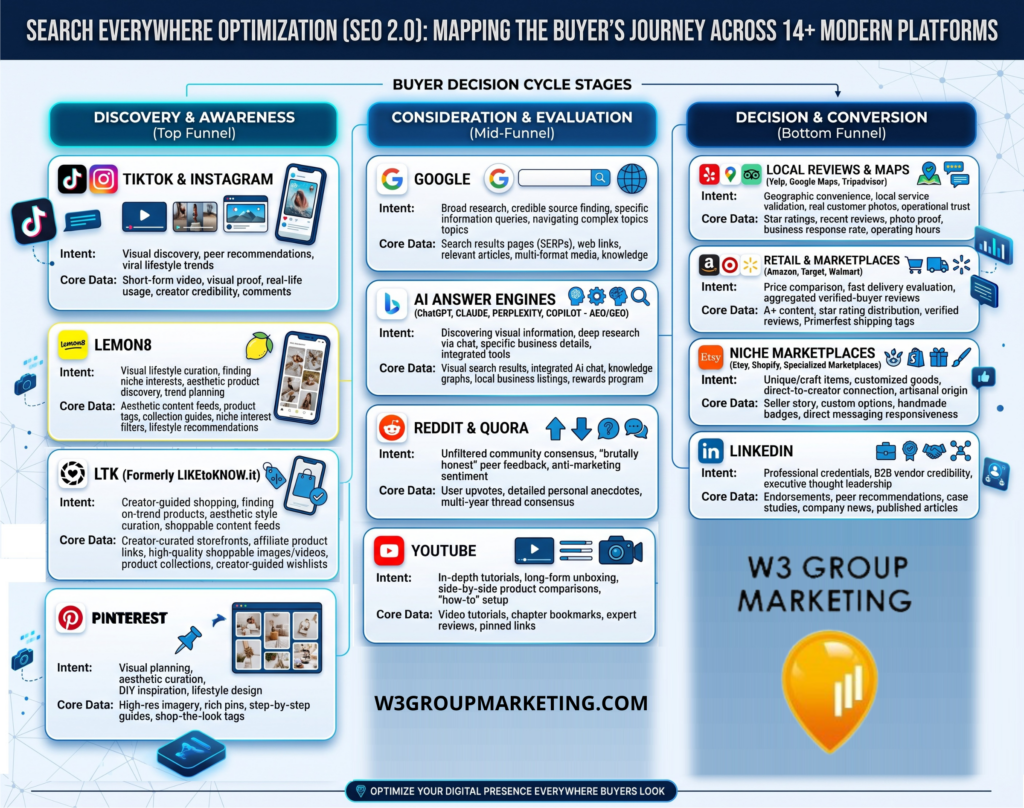
The 3-Stage Multi-Platform Buyer Decision Cycle
To build an effective Search Everywhere strategy, you must first understand how consumers move through the modern search funnel across 14+ major digital channels.
Stage 1: Discovery & Awareness (Top Funnel)
At the top of the funnel, consumers aren’t necessarily looking for a specific brand or product name. They are seeking inspiration, visual proof, aesthetic direction, and trend ideas.
1. TikTok & Instagram
- Primary Intent: Visual discovery, trend validation, peer-to-peer recommendations.
- What Buyers Look At: Short-form vertical video, real-life usage proof, creator credibility, user comments, and visual aesthetic.
- SEO 2.0 Focus: On-screen text captions, audio keyword optimization, and spoken keyword targeting for social search algorithms.
2. Pinterest
- Primary Intent: Visual planning, aesthetic curation, lifestyle design, and DIY inspiration.
- What Buyers Look At: High-resolution vertical pins, rich product pins, step-by-step guides, and “Shop-the-Look” tags.
- SEO 2.0 Focus: Board title keyword alignment, rich pin metadata, and visually searchable product graphics.
3. Lemon8
- Primary Intent: Niche interest discovery, aesthetic product recommendations, lifestyle curations, and flat-lay product breakdowns.
- What Buyers Look At: Carousel photo posts, curated aesthetic feeds, text-overlay guides, and category-filtered recommendations.
- SEO 2.0 Focus: Tagging relevant niche categories, rich photo descriptions, and aesthetic, guide-style content.
4. LTK (Formerly LIKEtoKNOW.it)
- Primary Intent: Creator-guided shopping, influencer style curation, finding exact outfit/decor links, and shoppable product feeds.
- What Buyers Look At: Creator-curated storefronts, affiliate product tags, high-quality shoppable images/videos, and creator wishlists.
- SEO 2.0 Focus: Influencer affiliate relationships, product catalog integration, and shoppable asset tagging.
Stage 2: Consideration & Evaluation (Mid-Funnel)
Once buyers identify a need, they switch from passive browsing to active evaluation. In this stage, they compare options, research alternatives, and seek unedited opinions.
5. Google & Bing (Traditional Search)
- Primary Intent: Broad topic research, accessing primary source documents, deep content navigation, and specific navigational queries.
- What Buyers Look At: Search Engine Results Pages (SERPs), authoritative articles, structured knowledge panels, and multi-format media.
- SEO 2.0 Focus: High-quality technical SEO, schema markup, comprehensive long-form content, and authoritative backlink profiles.
6. AI Answer Engines (ChatGPT, Claude, Perplexity, Copilot)
- Primary Intent: Synthesizing complex information, direct conversational answers, feature-by-feature comparisons, and receiving AI-filtered recommendations.
- What Buyers Look At: Machine-generated summaries, entity relationships, structured web data, and cited source links.
- SEO 2.0 Focus: Answer Engine Optimization (AEO) and Generative Engine Optimization (GEO)—structuring clear brand messaging, maintaining digital consensus, and optimizing for LLM citation crawlers.
7. YouTube
- Primary Intent: In-depth product tutorials, long-form unboxing videos, side-by-side video comparisons, and “how-to” demonstrations.
- What Buyers Look At: Video chapter timestamps, expert creator reviews, pinned link comments, and high-production video quality.
- SEO 2.0 Focus: Optimized video titles, rich description keyword targeting, closed caption files, and detailed video chapter timestamps.
8. Reddit & Quora
- Primary Intent: Seeking unfiltered, “brutally honest” peer consensus, personal anecdotes, and real user feedback devoid of marketing speak.
- What Buyers Look At: Upvote-to-downvote ratios, multi-year thread consensus, verified buyer stories, and community commentary.
- SEO 2.0 Focus: Community engagement, responding to category discussions, and monitoring brand mention sentiment across active subreddits.
Stage 3: Decision & Conversion (Bottom Funnel)
At the bottom of the funnel, the buyer is ready to take action. They are looking for local proximity, fast delivery, price verification, or business trust validation.
9. Local Reviews & Maps (Google Maps, Yelp, Tripadvisor)
- Primary Intent: Geographic convenience, local service validation, operating hours, and customer service reliability.
- What Buyers Look At: Star rating averages, recent review recency, real customer photo proof, and business owner response rate.
- SEO 2.0 Focus: Google Business Profile optimization, local citations, review collection campaigns, and accurate NAP (Name, Address, Phone) consistency.
10. Retail & E-Commerce Marketplaces (Amazon, Target, Walmart)
- Primary Intent: Price comparison, verified customer review evaluation, fast shipping guarantees, and direct checkout.
- What Buyers Look At: A+ content, star rating distributions, verified buyer badges, and Prime/fast delivery availability.
- SEO 2.0 Focus: Amazon A+ content optimization, high-converting product listings, keyword-rich title tags, and review management.
11. Niche & Artisanal Marketplaces (Etsy, Shopify Stores)
- Primary Intent: Sourcing unique or customized products, supporting direct-to-creator businesses, and artisanal origin transparency.
- What Buyers Look At: Seller story, custom option configurations, handmade verification badges, and seller response times.
- SEO 2.0 Focus: On-platform marketplace tag optimization, seller storefront storytelling, and direct customer engagement.
12. LinkedIn
- Primary Intent: B2B vendor vetting, executive credentials verification, corporate thought leadership, and professional recommendations.
- What Buyers Look At: Peer endorsements, case study articles, corporate updates, and leadership content authority.
- SEO 2.0 Focus: Executive profile optimization, publishing thought leadership articles, employee brand amplification, and B2B showcase pages.
Why Your Business Needs a Search Everywhere Strategy
Focusing exclusively on traditional search engine rankings leaves your brand vulnerable to losing prospects at every other stage of the customer journey.
By implementing a Search Everywhere Optimization framework, you ensure that:
- You capture demand early on visual and social platforms before buyers ever type a query into a search bar.
- You build bulletproof credibility when AI answer engines and community forums evaluate your brand reputation.
- You maximize conversion rates by maintaining strong visibility on review sites, local maps, and checkout marketplaces.
Ready to Evaluate Your Brand’s Search Footprint?
At W3 Group Marketing, we help businesses audit, optimize, and dominate their digital footprint across every modern search touchpoint. Contact our team today to run a complete Search Everywhere Audit for your business.